
Empirically Derived Resolution Limits for Discrete Object Detection with GPR
Achieving the highest resolution detection limits with high-frequency (800MHz) GPR can be challenging, but with the right survey design and robust positioning, the results can be very impressive. As with acoustic methods, the limiting factor with high-frequency GPR is often horizontal resolution, so keen attention to expected depth and associated pre-migration Fresnel zones is critical in survey design.
In the empirical test presented here, we prepared a 36 square foot test bed by excavating, removing all roots and debris beyond the depth of interest, and tamping the soil back into the bed (Figure 1).

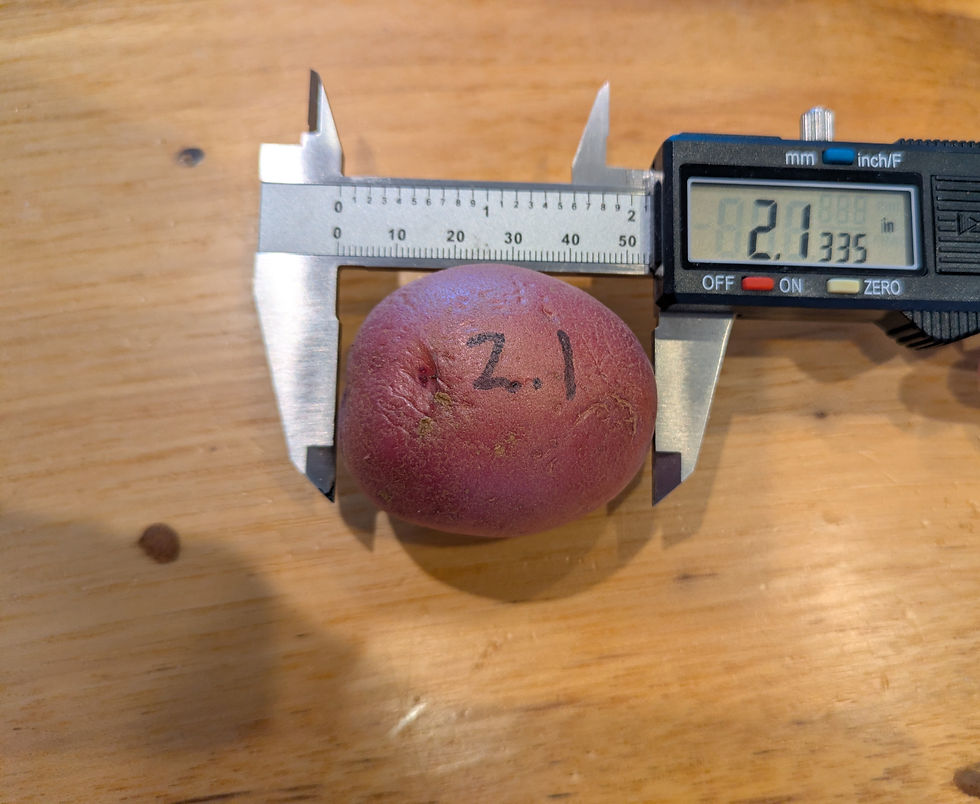
We then selected 8 small potatoes ranging from 2.1 to 1.4 inches (largest dimension) and one additional group of 4 randomly sized potatoes within this range (Figures 2 & 3).
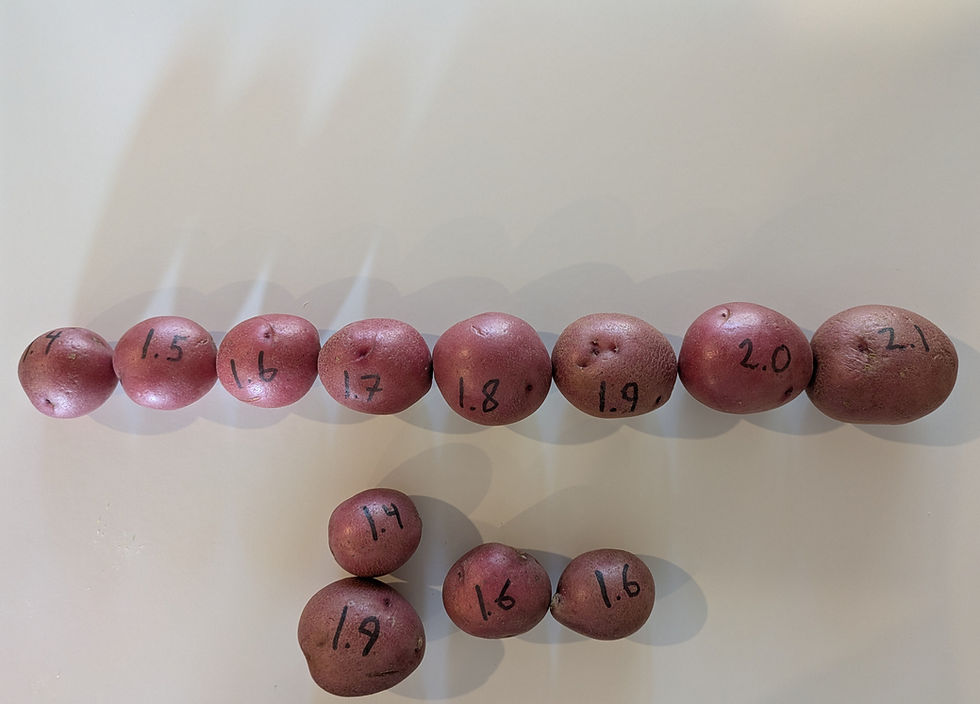
The potatoes were then placed in a precise geometric pattern with the largest potato at the NE corner and the smallest at the SW. The 4 additional potatoes were placed in a tight group with 1 inch between quadrants (Figure 4). All potatoes were then buried such that the tops were at approximately 4 inches below the soil surface. The individually arranged potatoes establish size based detection limits (and potential imaging distortion) and the group establishes horizontal resolution and discrimination potential.

Following a relatively standard processing sequence, including 3d migration, amplitude slices were extracted for analysis (Figures 5 & 6). The results clearly show that the entire size range of potatoes were detected as discrete amplitude anomalies in multiple, progressive depth slices. Very little to no distortion is evident in the geometric pattern. In regard to discrimination, 3 of the 4 potatoes in the group were clearly resolved, with the 4th present, but not as discrete from those on either side.

These results empirically illustrate the potential for GPR in the detection of discrete objects as small as 1.4 inches in diameter (perhaps smaller) and the discrimination of objects with as little as 1 inch horizontal separation. Beyond simple detection, the potential for 4d optimized surveys to characterize time-dependent sub-surface changes is high.


Comments